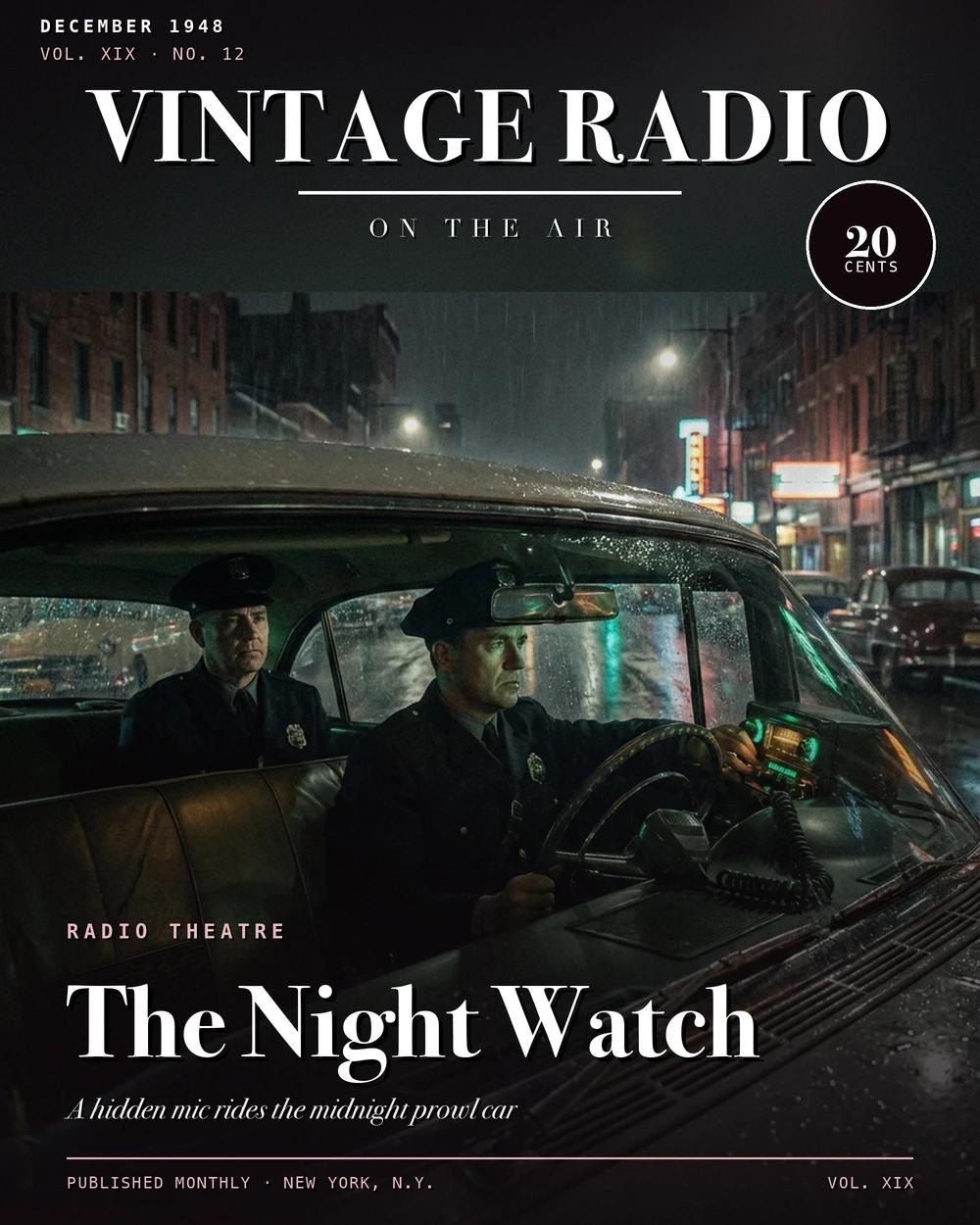
The Night Watch
The Idea That Changed What Radio Could Do
Before reality television had a name, a reporter named Donn Reed strapped a reel-to-reel tape recorder to his back, tucked a microphone inside a flashlight casing, and climbed into a Culver City police cruiser to record whatever happened next. That was the premise behind The Night Watch, and it was unlike anything CBS had aired before. The show's opening announcement said it plainly: "The sounds you are hearing are real. Remember all the people you hear are not actors. All voices and sounds are authentic." No dramatic music, no sound effects, no hired talent — just the police radio, the shuffle of feet, and real people in real trouble.
The series ran on CBS from April 5, 1954 to April 21, 1955, broadcasting weekly in a 30-minute format. It's been called an inevitable product of Dragnet's success, and there's truth to that — the appetite for police procedurals was real. But where Dragnet reconstructed crime through actors and scripts, The Night Watch went further, or tried to, by putting the microphone directly at the scene. It was the crime documentary format taken to its logical limit.
The concept had an accidental beginning. Reed met Sgt. Ron Perkins of the Culver City Police Department by chance at a handball court. After listening to Perkins describe his cases, Reed drew up a proposal for the program. Within months they were riding together during the 6 p.m. to 2 a.m. shift, with Reed hidden-wired and Perkins working cases as he always had — except now everything was being recorded. The police car itself was designed to look like a civilian vehicle so the pair could approach scenes without tipping off suspects.
How They Got the Audio
The technical setup was as improvised as the concept. Reed powered his recorder on dry-cell batteries, carried the unit on his back, and ran the microphone lead into that hollowed-out flashlight casing. It was portable enough to follow Perkins wherever a call took them, and inconspicuous enough that subjects rarely knew they were being recorded.
By the time CBS aired the premiere, Reed had already accumulated 100 reels of tape. That pre-broadcast material included criminals caught in the act, a homicide confession, and "the statement of a dope fiend." The production wasn't without risk. During the ride-along period, Reed was nearly shot in one incident and stabbed in another; a leather jacket absorbed the second blow.
Ray Gerhardt served as editor, and his job was more than trimming for time. Every broadcast episode had all real names and identifiable locales removed before it went to air. Profanity was cut as well — though unedited outtakes preserving that audio have survived among collectors. What remained was edited into a coherent half-hour, with Reed providing low-key bridging narration — he called himself a "Police Recorder" on air, not a reporter — to connect moments that the raw audio alone couldn't explain. Each episode closed with a summation from Chief of Police W. H. Hildebrand, lending the program an official stamp. Sgt. Perkins functioned as both the featured officer and the show's technical advisor throughout the run. William Froug supervised the production for CBS, Sterling Tracy and Jim Hadlock produced it, Vernon McKenny handled engineering, and Dan Cubberly announced.
What Made It Onto the Air
The range of material Reed and Perkins captured was wide. A given episode might move from a domestic dispute between spouses to an illegal gambling raid to a would-be jumper on a bridge. Listeners heard sanitarium escapees, attempted murders, drunk disorderlies, burglars, and parents in confrontations with their teenage children. None of it was staged, none of it was softened beyond the name removals and the profanity edits.
A contemporary article noted that the show "went on the air a month ago and already has aroused more comment than any new show in years." That kind of reaction, this early, was unusual. CBS carried the program as a sustaining broadcast — unsponsored throughout its run — which meant there was no advertiser pressure shaping what made it on air. The network was running it on its own, which itself says something about how seriously it was taken.
The program moved around the schedule considerably, starting on Mondays at 10, shifting to Fridays at 9:30, then Saturdays at 8:30, and finally settling into Thursdays at 8:30. Over roughly 52 weeks it produced 52 episodes.
What Happened to Everyone Involved
When The Night Watch ended in April 1955, Reed didn't walk away from the concept immediately. He auditioned a follow-up program tentatively called Police Recorder, which would have combined field recordings with commentary from a police psychologist. That project never advanced past the audition stage.
What did advance was a television version. Bill Burrud Productions picked up the concept for KCOP-TV in Los Angeles, airing Wednesday nights, with Reed and Perkins now working as "Detective Unit Five Six." Burrud, better known for travel programs like Wanderlust and Vagabond, was reportedly the only producer willing to take on the logistical difficulties of filming police work at night. The TV version operated under Culver City's new chief, Eugene Mueller, who cooperated with the production.
Reed's career took a sharply different turn from there. In 1957 he co-founded AirWatch with pilot Max Schumacher at KABC-AM — one of the earliest airborne drive-time traffic reporting services. A helicopter crash in 1958 severely injured both men and ended that chapter. Reed moved to KMPC radio in 1961 and stayed there until 1981, winning multiple Golden Mike awards during those two decades. He died on December 15, 2003, at age 88, at his home in Tarzana, California.
Reed's radio career had started in 1937 as an announcer and actor at CBS, covering dance bands among other work. During World War II he navigated B-17 bombers in North Africa for the Army Air Forces, suffering a broken back and stomach wound that left him an invalid until 1948. His return to radio after that recovery was as a producer, which is the role that eventually brought him to The Night Watch.
Sgt. Perkins stayed with the Culver City Police Department long enough to retire at the rank of captain, then served on the Culver City city council and later on La Quinta's as well. His son, Ron Perkins Jr., also retired from the Culver City department. The elder Perkins died in 2008.
Why It Still Gets Talked About
OTR researchers have consistently characterized The Night Watch as a forerunner of the reality television genre, with the Fox program COPS — which premiered in 1989, more than three decades later — frequently cited as its clearest descendant. The comparison isn't a stretch. The format is nearly identical: a camera (or in this case a microphone) rides with working police officers and records whatever comes up, with the results edited into episodes. The Night Watch was doing this in 1954.
The audition episode, recorded January 7, 1954 — several months before the premiere — survives, along with a substantial number of the broadcast episodes. Other Culver City officers heard across surviving recordings, identified by a local resident who recognized their voices, include Sgt. Bob Conlon and Lt. Charles Lugo. They're small details, but they add texture to how rooted this program was in a specific place and a specific department, working out of the 1928 city hall building on Duquesne Avenue.
As a piece of Crime-Detective radio, The Night Watch sits in its own category. It wasn't trying to dramatize crime; it was trying to document it, in real time, with the tools available in 1954. That it managed 52 episodes without a commercial sponsor, during a period when nearly every CBS program was underwritten by an advertiser, suggests the network understood it had something genuinely unusual on its hands.